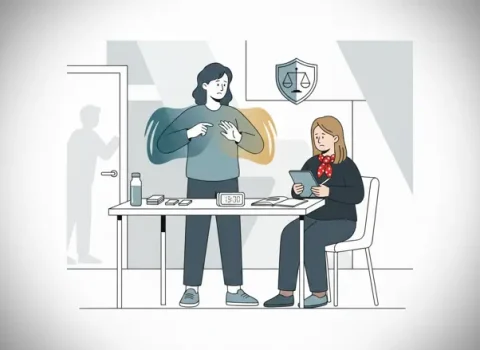
“Tests, nerves, triumphs: How interpreters survive assessment day.”
Assessment days are a unique challenge for interpreters. Whether it’s a formal qualification exam, an internal observation, or a performance review, they bring a mixture of nerves, pressure, and high expectations. Having been through it myself as a trainee—and now on the other side as a teacher and assessor—I know exactly what it feels like to balance technical accuracy, professionalism, and self-confidence under scrutiny.
One of the first lessons I share with trainees is that assessment is not about perfection—it’s about competence and adaptability. No two clients, assignments, or situations are ever identical, and assessment aims to measure how well an interpreter can navigate that unpredictability while maintaining ethical and professional standards. Being a CODA adds another layer: my early exposure to BSL and Deaf culture gives me instinctive awareness, but I also have to consciously manage nerves, stay present, and apply structured techniques to remain consistent.
Treat assessments like a normal assignment. I encourage trainees to approach each evaluation as if it’s just another client. You might have five to ten minutes beforehand to introduce yourself, acclimatise to their signing style, or ask polite questions to clarify expectations. This reframing grounds you in the interaction rather than the stress of evaluation, helping both performance and professionalism.
I’ll be honest—I’ve never been a huge fan of tests. But I’m not new to being in the spotlight. From a very young age, I was “the interpreter”, so attention and questions directed at me were the norm. As an adult, it can sometimes feel a bit strange when I’m not needed—there’s a touch of FOMO there! That early experience has taught me to stay composed under observation and to channel attention into purposeful action rather than nerves.
It’s also worth remembering that not every CODA has the same advantage. Our experiences, exposure, and ambitions differ greatly. My brother, for example, chose not to progress beyond BSL Level 3, even though I know he could interpret—and do it exceptionally well—with further training. His go-to approach was classic: when faced with a hearing person who didn’t understand BSL, he would simply say, “Go, learn how to sign,” and walk away—leaving my dad and the hearing person to try and work it out themselves. Cue the inevitable intervention from ‘big sister’! These moments highlight that CODAs, even within the same family, can have very different styles and comfort levels, and that navigating communication challenges often requires creativity, patience, and a little humour.
I’ve also seen how emotionally charged assessments can be for students. Some arrive and start to cry as soon as they see the room. I have sympathy—it’s not easy learning a visual language in a hearing-dominated world. Audism is everywhere, even in subtle everyday interactions: the way emails are signed off, assumptions about what a deaf or signing person “should” do, or the constant implicit message that hearing ways are default. These pressures are deeply entrenched, and for learners, the weight of navigating a hearing world while being observed can feel overwhelming. Part of my role is to acknowledge that, offer support, and help them channel nerves into focus rather than fear.
Real-life assignments can throw up surprises, even for experienced interpreters. One memorable moment with my dad illustrates this perfectly: he once walked me straight into the NHS CEO’s office—no warning, no explanation. I was covering for a sick colleague, and there I stood while the CEO sat at her desk, looking shocked but smiling. She knew my dad immediately, and I had to handle the situation professionally while internally screaming, “What are you doing?!” It turned out he just wanted to show me off. Thankfully, she was kind and gracious, and I even got to see her again around the hospital later. Moments like this highlight that interpreting is about quick thinking, composure, and a sense of humour, especially when unexpected scenarios arise.
Preparation is key. Before any assessment, I encourage trainees to:
- Review and refresh skills: revisiting vocabulary, handshapes, and interpreting strategies.
- Visualise the scenario: mentally walk through the assignment, anticipate challenges, and plan responses.
- Reflect on past experiences: identify lessons learned from real-world assignments to apply under pressure.
But assessment isn’t just about technical skill. Interpersonal dynamics play a huge role. How you establish rapport, read non-verbal cues, and manage stress affects both your performance and the client’s experience. Even small gestures—pausing, clarifying, or adjusting tempo—can make a big difference in maintaining clarity and trust.
Pressure is inevitable, but it can also be constructive. Learning to embrace nerves as focus and channel energy into precision and responsiveness is a critical skill. I often remind trainees—and myself—that mistakes are part of learning. What matters is recovery, reflection, and the ability to adapt in real-time. Finally, assessment is a reminder of the ethical responsibility we carry as interpreters. Upholding confidentiality, impartiality, and professionalism under observation reinforces why we do what we do every day. Handling pressure effectively is not just about passing a test—it’s about being prepared to meet the challenges of real-life interpreting with confidence, integrity, and poise.
