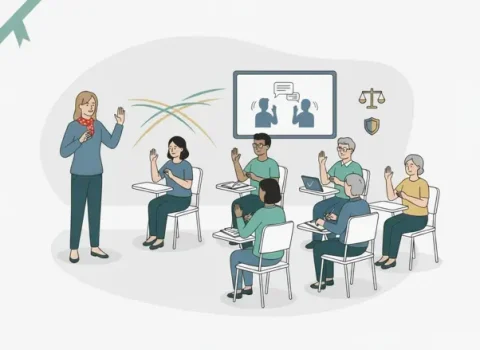
“Teaching hands, shaping futures: Behind-the-scenes of interpreter training.”
Training and assessing trainee interpreters is one of the most rewarding aspects of my work. It’s not just about ensuring that meaning is conveyed in interpreting assignments—it’s about shaping confident, ethical professionals who can navigate the complexities of real-world interpreting. Every trainee brings their own background, strengths, and challenges, and part of my role is helping them discover their potential while guiding them to meet professional standards.
My approach is shaped by a lifetime immersed in BSL. Growing up as a CODA, I learned early on that language is not just about vocabulary; it’s about nuance, culture, and human connection. My dad, in particular, taught me the importance of sharing knowledge without superiority. His endless patience—partly shaped by the challenges of his own childhood and partly by recognizing the benefits of patience—has been one of my greatest influences as a teacher.
As a trainer, I’ve had to greatly modify my knee-jerk responses over time. There were plenty of “police officer moments” in my life that taught me how to manage frustration, communicate clearly, and maintain composure. Supporting my mum—who has partial sight and a prosthetic leg—often required real-time audio description and careful guidance through uneven pavements. These experiences taught me to anticipate challenges, adapt communication strategies quickly, and approach teaching with empathy and flexibility.
Assessment is never about pointing out mistakes for the sake of it—it’s about fostering growth. I provide constructive feedback, highlight areas for improvement, and guide trainees to develop strategies for managing real-life assignments. Sometimes this means role-playing challenging situations, other times it’s observing and debriefing actual interpreting sessions. The goal is always the same: helping them become confident, competent, and ethical practitioners.
I also engage in structured, ongoing training myself so that I can bring fresh, current content to my learners. For trainees to be confident and competent, they need more than just fluency—they need up-to-date knowledge of trends in the industry and practical strategies to continue learning and engaging with BSL for themselves throughout their careers. By modelling this approach, I help them see that professional growth is continuous, and that staying informed and curious is part of being an effective interpreter.
I also bring in other industry professionals—some from the Deaf community, others from medical, educational, and legal backgrounds—so learners can engage in a safe space and explore where their work as a Sign Language Interpreter might take them. This exposure allows trainees to see a variety of real-world scenarios, ask questions, and understand the nuances of different sectors, all while building confidence in their skills and professional judgement.
Discussions with other teachers have also been invaluable. While most are SLIs, not all are, and their own experiences—both domestic and commercial—feed into a rich range of examples and teaching moments that I can utilise for the benefit of trainees. This collaborative approach allows learners to engage with multiple perspectives, see the variety of real-world challenges, and gain insights that extend beyond the classroom.
One of the most important aspects of training is modeling professional boundaries and ethical behaviour. I teach trainees that an interpreter is not just a conduit—they are mitigating gaps between the Deaf and hearing worlds. We educate our clients, both hearing and Deaf, and remain sensitive to the nuances of communication and deep-rooted cultural norms. Fluency is essential, but understanding professional codes, maintaining impartiality, and managing interpersonal dynamics are equally critical. I share stories from my own career—both successes and missteps—to illustrate how these principles play out in practice. It’s incredibly fulfilling to see trainees grow. From hesitant beginners to confident practitioners, watching that transformation reminds me why I love this work. Teaching and assessing isn’t just about passing exams—it’s about nurturing a new generation of interpreters who can uphold the integrity, professionalism, and cultural understanding that the Deaf community deserves.
