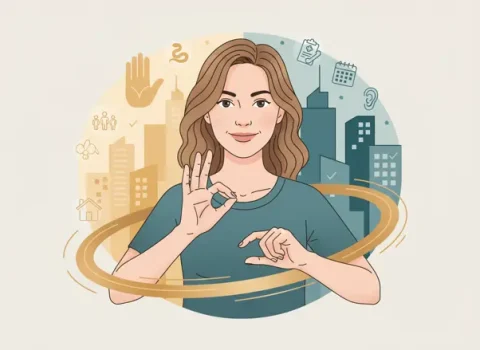
“Why I turned childhood hands into a career in BSL.”
BSL was always part of my life. Growing up as a CODA, I navigated two worlds: the Deaf world of my parents and the hearing world outside. My hands were my voice from an early age, and communication wasn’t just about words—it was about connection, culture, and understanding.
But, to be honest, I didn’t choose to become an interpreter straight away. In fact, I managed to avoid it until I was 21. Before that, I had a rather eclectic work history. I spent time breeding reptiles—yes, snakes and lizards—which taught me patience, observation, and the importance of reading non-verbal cues. I worked as a personal assistant for a private medical doctor, juggling diaries, urgent phone calls, and high-pressure situations where mistakes were not an option.
I also had a stint in the print industry during the MAD Cow Saga. Surrounded by frantic farmers, I was issuing ear tags, managing paperwork, and keeping up with constantly changing deadlines. It was chaotic, sometimes hilarious, and a real test of organisation and calm under pressure. Those experiences taught me resilience, problem-solving, and how to handle people from all walks of life—a surprisingly useful skill for interpreting later on.
In my early twenties, I had an unusual opportunity: a job helping disabled people into work. This required me to prepare a presentation for a panel, demonstrating how I could convince employers to take on disabled candidates. Initially, it felt strange—my entire family were either blind, dyslexic, autistic, and in my dad’s case, Deaf. They had always worked, and if anything needed negotiating, we handled it “in-house.” Drawing on my upbringing and practical understanding of disability, I delivered the presentation and wowed the panel, landing the job.
Once I was in the role, I realised that while I could engage fully with Deaf clients, it was important they remained in control of their own experience. So I started introducing experienced CSWs (this was back in the 90s) and qualified interpreters, explaining the importance of access and arranging it between clients and employers. This early advocacy helped me understand the profound value of professional interpreting—not just as a skill, but as a tool for empowerment and autonomy.
It wasn’t long before this job led me to set up my own company. The demand was overwhelming—people were coming to me asking for help in ways I couldn’t meet alone. I realised I needed a team of like-minded people: some CODAs, some not; some disabled, some not; some BSL-fluent, some not. A truly diverse mix.
What bound us together wasn’t just skills or qualifications—it was genuine empathy. We were motivated to do our absolute best to level the playing field, helping people navigate the “rat race” and access opportunities that might otherwise have been closed to them. That spirit—of inclusion, understanding, and empowerment—remains central to everything I do today, whether I’m interpreting, teaching, or mentoring the next generation of BSL interpreters.
Choosing interpreting wasn’t about a straight path or early ambition—it was about recognising where my natural skills, values, and passions could meet meaningful work. Looking back, it’s clear that every stage of my journey—from childhood in a BSL household, through eclectic early jobs, advocacy, and entrepreneurship—was building the skills, resilience, and insight that led me to this career.
Today, interpreting is more than a job—it’s a bridge, a way to connect worlds, empower people, and turn something deeply personal from my childhood into meaningful professional work. And I wouldn’t have it any other way.
